




Sunita -
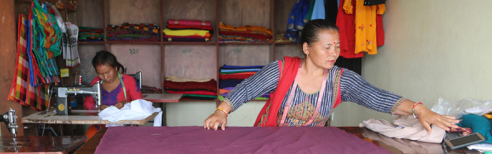
Sunita, a construction worker and internal migrant, lives in Kathmandu with her husband and two children. When Sunita first moved to Kathmandu more than 15 years ago, the rainfall used to be on time and the seasons occurred as expected.
She mentions now everything has changed, “it rains any time, it's generally hot and drought has increased which burns everything. There is a lot of difference. Time is not good now.”
As an outdoor construction worker, Sunita faces the impacts of extreme weather both at her workplace and at home. With job precarity and limited means to support her family, she also has limited means to cope with the heat. During work hours, she and her co-workers try to find shade from the scorching sun, but on an outdoor construction site with the risk of losing wages for work not completed, their time in shade is limited. At home, she faces threats like dengue. Illness could lead to added expenses for Sunita and her family, who are barely managing. She mentions, “We get mosquitoes here [in the settlement]. The mosquitoes with long legs which were usually seen in Terai are seen here nowadays. There are many in number nowadays. These are the mosquitoes which bring dengue.” To protect themselves, they buy mosquito coils; there is no government intervention.
In the absence of outside support, Sunita has searched for work as a domestic worker: it pays less, but it is indoors. She says, “I thought I would search for other types of work like domestic work. Then I wouldn’t even need to work in extreme heat or rain. I searched a lot for domestic work where I can work inside a house which is comparatively easier. However, I have not been able to find such work. I went to areas like Bhaisepati, Nakkhu which are a bit away from where I live but there isn’t domestic work available there as well. It is really difficult to get work in Kathmandu.”
Prakash -
Prakash, a temporary resident of Kathmandu, has been living in the city for over 40 years. He moved to the capital with his parents when he was just 2-3 years old, and left his education in 10th grade to support his family as the primary breadwinner due to his father's untimely demise. Currently, he works as an airport taxi driver ferrying passengers across the city. The lack of fixed rates for taxis in Kathmandu makes Prakash’s income extremely volatile.
As a taxi driver, tourism is Prakash’s biggest source of earning. Tourists have historically travelled to Kathmandu for its pleasant weather, but with increasing heat and potential heatwaves in the city, this could shift. His current situation at work requires him to constantly be moving, including searching for passengers at the airport, “It is very difficult to work when the hot wind blows. We normally have to go and look for passengers in the airport. When we go in search of them, the body gets heated during hotter days. It gets very difficult to work. One, two of our friends had fainted earlier while working in the heat. We took them to the hospital when they fainted. It is difficult to work on such days when there is a heat wave.”
To help drivers like Prakash cope with these conditions, the company provides a tank of free and accessible drinking water where they can fill bottles. There is also a mandate by higher company officials that they should be hydrated to avoid health issues. However, Prakash mentions, “If we drink a lot of water, we face problems – we need to go to the restroom which isn't easily accessible in the airport areas. We face dual challenges – problems if we drink less water and [problems if] we don’t find a toilet if we drink enough water.” Another coping mechanism that Prakash mentions is sitting in air-conditioned restaurants during extreme heat; however, this means fewer passengers and therefore lower wages for the day.
For drivers like Prakash, lack of rest areas and accessible bathrooms at their public workplace, the airport, leads to health issues, lower productivity, and in some cases, wage loss.

