



×

Fill Out The Form Below To Download Report

By ticking this box, you acknowledge and agree that People’s Courage International retains all intellectual property rights and ownership over the data provided herein. Any publication, presentation, or public dissemination of this data must include an explicit citation of People’s Courage International as the data source. You agree not to reproduce, distribute, sublicense, or share this data with any third party without written consent.

I have read and agree to the Data Use Terms and Conditions of People’s Courage International.

For any questions, write to research@peoplescourageinternational.org

Delhi

India has witnessed significant warming, with the annual mean temperature in 2021 registering 0.44°C above the 1981–2010 average. Delhi, India’s capital, is among the hottest and most vulnerable cities due to its dense population and large low-income communities.  This page gives an overview of what informal workers in Delhi undergo through when impacted by increasing heat. It presents socio-demographic details of workers in Delhi, detailed impacts on work and households, coping strategies and external assistance  available to them through data and first hand narratives. 

Annual Mean Temperature

1901 – 2024 · °C

TEMPERATURE
LINEAR TREND

World Bank Group. (n.d.). Climate Knowledge Portal: India

Some key insights on increasing temperatures include

Who are these workers?

What is the age of the surveyed respondents?

Majority of the respondents surveyed fall in the age of 25 to 34 years, followed by close to one-third who are between 35 to 60 years of age. The predominance of a middle age group in the informal sector suggests that most may have significant financial responsibilities.

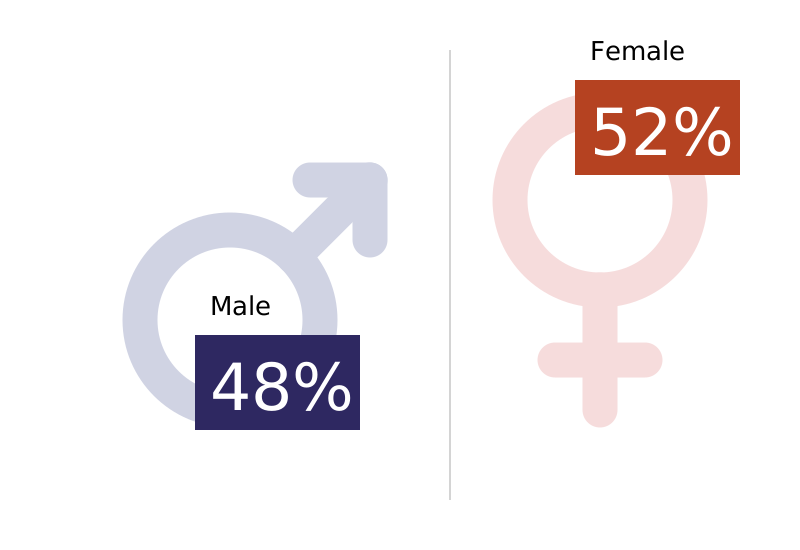
What is the gender of the surveyed respondents?

Over half of the respondents surveyed were women, in line with national statistics on the rising participation of women in informal work. This could be attributed to rising urban expenditures and increasing household financial responsibilities that make it necessary for women to engage in income-generating work. This also pushes us towards reflecting on existing migration trends where women are generally considered as associational migrants.

Migration Trends and Patterns

Why are people migrating?

Majority of the respondents chose to migrate due to economic factors at their source locations, including lack of job opportunities and lower wages, indicating how destination cities serve as avenues for better livelihood opportunities for these workers.

Why are migrants choosing certain destination locations?

Majority of these workers choose their destination cities on the basis of better employment opportunities and healthcare facilities, reflecting how cities provide better access to essential services and improved livelihood opportunities.

Who are they migrating with?

A large proportion of respondents reported migrating with their spouse, followed by many who also move with their children. This reflects not only the need for support and social networks in new places, but also the pursuit of stable and better collective livelihood options for the entire family.

What duration are migrants moving for?

Most of the workers in our survey were long-term migrants or had migrated permanently to Delhi. These decisions could largely be driven by better long-term financial prospects and access to services in urban centres in comparison to their source locations.

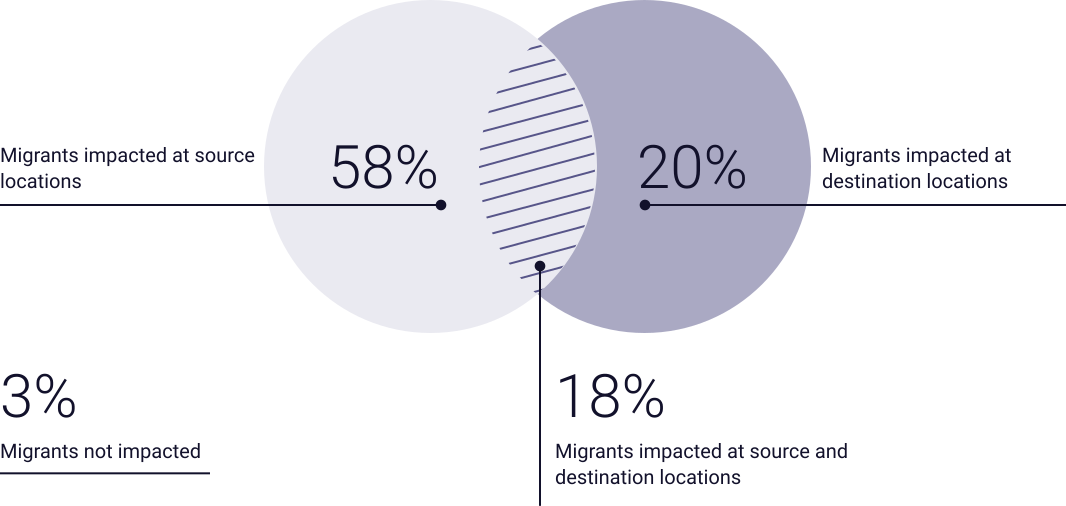
How many migrants are negatively impacted by extreme weather events?

Although, more than half of the workers mentioned getting severely impacted by extreme weather events at their source location, a significant section of workers get impacted at the destination locations as well.

In fact, many experience adverse impacts both at source and destination. This suggests that weather events are acting as  catalysts in influencing migration decisions but continue to add additional strain even after migration.

Extreme weather events workers face in cities

Delhi, with its varying climatic conditions, is prone to extreme weather events. 90% of the surveyed workers reported being affected by increasing heat, given that a large proportion of them work in outdoor settings, facing the brunt of extreme temperatures and constant exposure. Some of the workers further highlighted a noticeable shift in the city’s temperature with respect to the increased intensity and frequency in the past few years. These experiences underscore how extreme heat is being felt by these informal workers at the ground level.

So we’ve also noticed, the heat was always there in Delhi, but in the last few years it has increased

Akash, Construction worker, Delhi

Impacts on Work

Wage related problems

Heat is increasingly exacerbating the challenges faced by informal workers, with many reporting wage related issues such as wage loss and wage cuts.Additionally, the brunt of extreme heat makes workers unable to step out and work under such conditions.

arrow

Wage related problems

“In the summer, there’s no work. We stay at home. We can’t go out to work in that heat.”

- Praveen, construction worker, Delhi

arrow

Productivity losses and difficulty in working

A large proportion of these workers work outdoors and extreme heat limits their ability to work for long hours and reduces productivity.

Additionally, while working in such conditions, some of the construction workers mentioned wearing heavy safety gear without fans in “suffocating conditions”.

arrow

Productivity losses and difficulty in working

“If you wear the helmets and shoes for too long, it starts hurting. Your face gets red from the pressure and heat outside.No issue with glasses, but the shoes we wear are very heavy. When it’s hot, your feet sweat a lot inside the shoes”

- Rajat, construction worker, Delhi

arrow

Compromise to worker wellbeing

Workers reported limiting their water intake while working in such extreme heat due to the heightened monitoring further pushing them to exhaustion.

arrow

Compromise to worker wellbeing

“Our supervisors do not let us drink water. They say, if you drink water, then you will have to go to the bathroom, then it will take you 5-10 minutes to go to the bathroom. They just push us for work and we do it out of fear.”

- Aarti, factory worker, Delhi

arrow

Impacts on households

Health problems

Many workers experiencing health issues and food insecurity, as rising temperatures lead to spoilage of food, reduced appetite, and dehydration, increasing the likelihood of heat-related illnesses such as heatstroke, low blood pressure and headaches.

arrow

Health problems

“Sometimes our blood pressure drops and we feel dizzy. People faint. They can collapse anywhere due to the dizziness.”

- Vivek, construction worker, Delhi

arrow

Sleep and rest deprivation

With increasing heat, workers are unable to rest adequately, resulting in prolonged fatigue and further health stress. In the city, frequent power cuts during peak summer season combined with rising electricity costs due to surging demand add to the heat burden.

arrow

Sleep and rest deprivation

“It’s like our faces burn from the heat even inside the houses. There's no water. We can’t sleep properly at night. We feel restless in the morning. The situation is bad.”

- Lata, factory worker, Delhi

arrow

Layered challenges for women

For women, extreme heat adds an additional layer of burden, as they are required to manage both work and household responsibilities like cooking in such high temperatures with little to no respite.

arrow

Layered challenges for women

 “It gets stifling. When we cook……sweat starts pouring down.”

- Bina, factory worker, Delhi

arrow

Assistance received during and post extreme weather events

Complete lack of assistance

With adverse impacts on livelihoods and households, about half of the workers reported receiving no assistance during periods of increasing heat. Many workers complain that when they are in dire need, there is no one to help.

arrow

Limited support to workers

On a positive note, a significant proportion of workers mentioned receiving healthcare support and taking up additional employment to cope with these harsh conditions. Although workers experience some level of respite during such peak conditions, it remains insufficient. Other forms of support were accessed by only a small proportion of workers, further highlighting the gaps in the assistance provided.

arrow

Workers’ needs

Some workers expressed the need for assistance in the form of improved infrastructure and housing support to help them cope with such extreme weather conditions. They expressed that their current living situations feel like “containers” and they cannot get peaceful sleep even within the safety of their homes.

arrow

Workers’ needs

“We cannot get land here, however, proper houses can be built for us.”

- Kamal, construction worker, Delhi

arrow

Coping mechanisms adopted during extreme weather events

Maladaptive coping mechanisms

Following the lack of assistance received, workers primarily rely on using their savings to cope with such extreme events, further increasing their financial burden. When impacted by heat, 91% dip into their savings. A small proportion also depend on informal loans, which often trap them in a vicious cycle of debt, leading to heightened vulnerability.

arrow

Maladaptive coping mechanisms

“We manage sometimes by taking loans just to get through the summer.”

- Rakesh, construction worker, Delhi

arrow

Quick and easy remedies

In addition to this, many workers rely on temporary coping mechanisms such as increased hydration, which further raises their out-of-pocket expenses, or simple home remedies like placing a wet cloth on the body to manage heat.

arrow

Quick and easy remedies

“We all have our own ways. I wake up and drink buttermilk every day — it helps with hydration. I even carry some in my bag. When it gets too hot, I wash my face or wet a cloth and keep it on my head or face. It gives a cooling effect.”

- Vinod, construction worker, Delhi

arrow

Stories from the ground

Jai Singh -

Jai Singh, 45 years old, moved to Delhi more than two decades ago from Rajasthan. Faced with abject poverty back at home, he came to the city in search of economic opportunities. Since his arrival, Jai has worked in the construction sector as a labourer, barely supporting his three dependents. Construction work, whether outdoors or indoors, creates dual challenges for Jai Singh.

“When we get work, it’s both outdoors and indoors. Outdoors become challenging – it’s because of the direct sun exposure. However, even indoors work, we have problems as there’s usually no fan. Especially if it is a new construction site, then who will put a fan for us? Even indoors, we feel the heat. It feels suffocating. Sometimes we feel choked, we feel trapped. When we feel thirsty, there’s no water nearby. If we want to relieve ourselves, there’s no proper place. They tell us ‘don’t do it here,’ but where else can we go? So we have no choice.”

Jai Singh shared that health issues due to this type of work, such as headaches, dizziness and fainting, are rampant. This adds a burden on his income.

“Income has a double effect. Suppose I work today and fall sick tomorrow. Then I can’t go to work and earn, and still have to spend money on treatment.”

He recalled a health issue that he faced during extreme heat that he did not have the means to address. 

“Earlier I worked in Dharampur, I had a blood clot from working in extreme heat. They told me to have cold drinks, water, and coconut water. But coconut water costs ₹50. I couldn’t afford that.”

In the absence of social protections for workers like Jai Singh, they lack any means to cope with the increasing heat. Jai Singh mentioned that income support by the government would really help his family during this period, “If we could also get some unemployment allowance (berozgari ka bhatta), that would really help.”

Seema -

Seema moved to Delhi with her father over two decades ago, settled down in the city, and got married. Prior to giving birth, she had a stable factory job but eventually quit to take care of her child. However, over time, her family’s financial distress increased and Seema found another job, this time as a daily wage worker for different factories. At the workplace, Seema faces terrible working conditions which worsen during extreme heat.

She says, “It gets very hot. When we pick up the pieces, it feels hotter. We feel dizzy and go to drink water. The supervisor tells us, ‘You’re not working, then leave. So we have to go home.” Working conditions, coupled with a lack of rest time during long shifts, are brutal. When we go to the factory, they don’t give us enough time. We have to work at least eight hours, but even then there’s no drinking water. When we go to drink water, they tell us to hurry up. If we go to the bathroom, they call us back. Earlier we could sit while working, but now they make us stand the whole time — standing 12 hours is very hard.”

Yet, Seema avoids complaining or demanding too much from her employers – there are limited job opportunities available. Seema and her family’s challenges further intensify at home with health issues and compromised nutrition during extreme heat. She mentioned that the food she cooks often spoils during the summers, as her family cannot afford a refrigerator. Health issues are rampant which often lead to increased financial burdens on the household. She explains,

“Everything gets worse in the heat. Headache, piles, everything is because of heat. But we don’t have much money. If we go to a private hospital, it’s ₹500 to ₹700 just to see a doctor - even more at some places. If you go to quacks then there is risk of more infection. If I don’t get treatment at the government hospital, I buy medicine from a medical shop. If I don’t have money, I borrow from neighbours.”

These impacts cause havoc in the lives of workers like Seema who already face extreme financial insecurity. She barely has any ways to cope without increasing her family’s financial challenges. She concludes,

“We can’t change the weather. But if we earned more, we could buy better food: curd, milk, vegetables, things that help in the heat. Right now even a half-litre of milk costs Rs. 35. If we earned better, life would improve. If we earn well, we eat well, and then we can handle the weather better.”

Impacted by extreme weather events - this data represents workers who are impacted by various kinds of weather events.

Impacted by Heat and Other weather events - this data represents workers impacted by heat alone, as well as those impacted by heat in combination with other extreme weather events.